
Shipbuilding & Offshore
Seawater is the harshest natural electrolyte: roughly 19,000 ppm chloride plus wet-dry cycling and crevices. Here the first criterion is not strength — it is whether the material can withstand crevice corrosion.
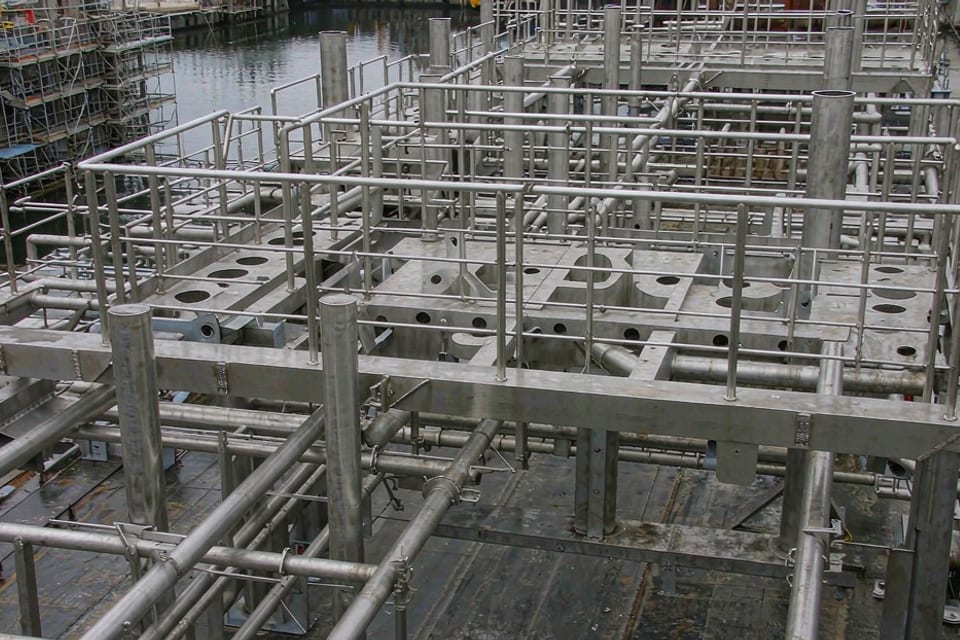
Typical Parts & Material Selection
| Part | Grade | Surface / Size | Watch Out For |
|---|---|---|---|
| Deck railing / fittings | 316L | Tube / profile, polished | Salt spray, post-weld passivation |
| Seawater piping | 2205 / 6Mo | Seamless / welded pipe | Pitting, flow erosion |
| LNG tank inner hull | 304L / 304 | 8–50 mm plate | Low-temperature toughness, class approval |
| Accommodation / galley equipment | 304 / 316L | 0.8–2 mm, 2B/HL | Cleanability, fingerprint resistance |
| Fasteners / fixings | 316 / 2205 | Bar / forging | Stress corrosion cracking |
Three real constraints in the industry
Crevice corrosion is the dominant failure mode
Under seals and at contact points between bracket and body, 304 rusts within months. Eliminate crevices by design (continuous weld seams, drain holes) and upgrade to 316L or 2205.
Confirm classification society certification as early as possible
DNV / ABS / LR / CCS each maintain their own approved material list. Better quality that is not approved still fails inspection — check at the quotation stage.
Welding distortion accumulates at assembly
Thin-walled fittings distort, and errors pile up in final assembly. Use anti-distortion fixtures in sub-assembly production and allow cutting margin.
Related Products
Need a Quote or Technical Support?
Send us the part, grade, size, quantity and destination port — we respond with FOB / CIF within 24 hours.